

Yes, a descriptive business name can sometimes receive trademark protection and federal registration, but it usually faces a harder path than a distinctive name. You may need to prove that customers recognize the wording as identifying one source, or seek the Supplemental Register if the name is eligible and in use. A generic name cannot be registered for the goods or services it names.
The answer depends on the name and the specific goods or services. A phrase may be descriptive in one market and distinctive in another. Registration also does not establish that the name is available to use; earlier similar marks remain a separate issue.
What makes a business name merely descriptive?
A name is merely descriptive when it immediately tells buyers an ingredient, quality, characteristic, function, feature, purpose, or use of the relevant goods or services. That is the standard summarized in TMEP §1209.01(b). The USPTO evaluates the wording in context, not in the abstract.
Hypothetical example: “Rapid Tax Filing” for tax-preparation services would likely communicate the nature and a claimed feature of the service immediately. The same wording could have a different significance for unrelated goods. This example has not been searched or cleared.
A descriptive name can be attractive because customers understand it quickly. The tradeoff is that competitors may need to use the same ordinary language. As a result, the name may be harder to register and the enforceable scope may remain narrow even after protection develops.

Descriptive, suggestive, and generic names are different
These categories turn on what the wording means to buyers in relation to the offering. The USPTO’s strong-trademark guidance explains the basic spectrum.
- Suggestive: The name hints at a feature or benefit and requires some imagination. Suggestive marks can be inherently distinctive.
- Descriptive: The name immediately conveys information about the goods or services. It generally needs acquired distinctiveness for the Principal Register.
- Generic: The wording is the common name of the product or service category. Generic matter cannot identify a single source for that category.
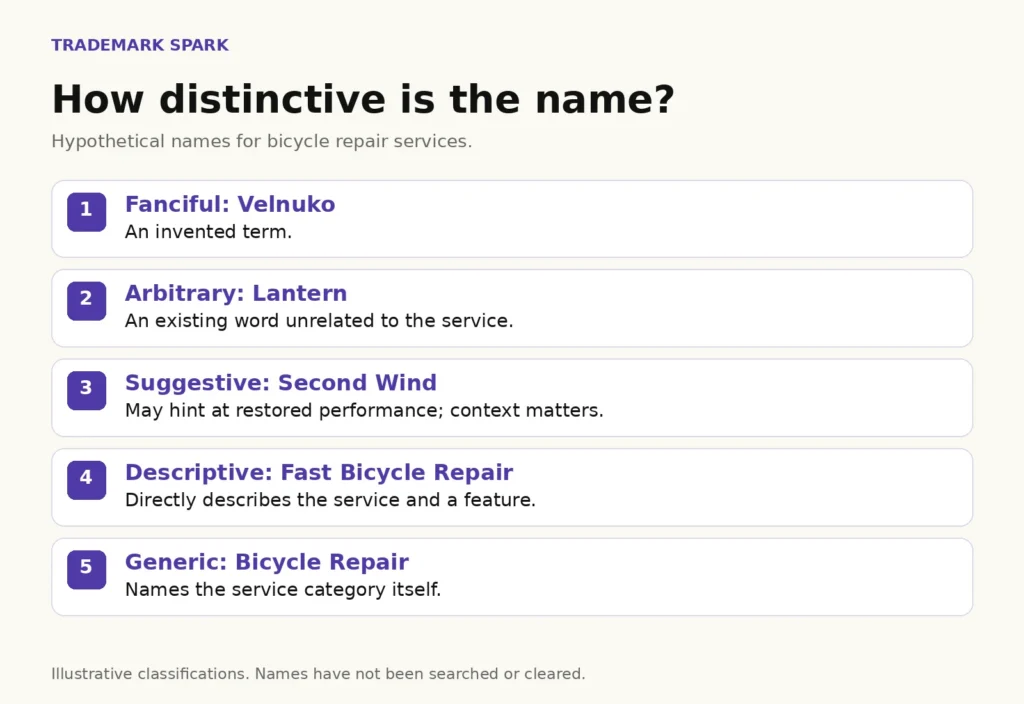
The boundary between suggestive and descriptive wording is often disputed. The boundary between descriptive and generic wording also matters because generic terms cannot acquire distinctiveness or register on either federal register. TMEP §1209.01(c) explains that the question is how the relevant purchasing public understands the term.
Three practical paths for a descriptive name
1. Prove acquired distinctiveness
A descriptive name may qualify for the Principal Register under Section 2(f) after it has acquired distinctiveness, sometimes called secondary meaning. The key question is whether relevant customers have come to understand the wording as identifying a single commercial source, even if they do not know the company’s legal name.
The USPTO identifies several forms of evidence, including the duration and extent of use, sales, advertising, statements from the trade or public, and other evidence showing customer recognition. More descriptive wording usually requires stronger proof.
2. Consider the Supplemental Register
The Supplemental Register can be available for a name that is capable of distinguishing the applicant’s goods or services but does not yet qualify for the Principal Register. For the usual U.S. use-based route, the mark must be in lawful use in commerce. Section 23 of the Trademark Act states the governing eligibility rule.
A Supplemental registration can support use of the ® symbol, appear in the USPTO database when later applications are examined, support a federal infringement action, and serve as a possible basis for foreign filings. The USPTO’s register comparison explains these benefits.
A Supplemental registration does not carry all Principal Register advantages, including the same statutory presumptions, constructive notice, or a path to incontestability.
A Supplemental registration does not automatically mature into a Principal registration. If the name later acquires distinctiveness, the owner generally files a new application for the Principal Register. Section 27 of the Trademark Act confirms that Supplemental registration does not block a later Principal Register application and is not an admission that distinctiveness has not been acquired.
3. Pair a distinctive brand with descriptive wording
A business can use a distinctive house brand together with wording that clearly explains the offering. This lets ordinary language do its informational job while the distinctive element serves as the main source identifier.
An application may require a disclaimer of descriptive wording, meaning the applicant does not claim exclusive rights in that wording apart from the mark as a whole.
Five years of use is not an automatic pass
Section 2(f) allows the USPTO to accept substantially exclusive and continuous use for the preceding five years as prima facie evidence in an appropriate case. It does not require the USPTO to accept five years alone for every name.
The current TMEP acquired-distinctiveness guidance explains that highly descriptive wording may require additional evidence. Large advertising expenditures or long sales history can still fall short if they do not show that customers associate the wording with one source. Widespread third-party use can also undercut a claim that use has been substantially exclusive.
- How long and how consistently the name has been used as a trademark.
- Whether comparable businesses use the same or similar descriptive wording.
- Sales, advertising reach, and the way the name appears in advertising.
- Customer or trade declarations tied to source recognition.
- Reliable survey or market-research evidence when the stakes justify it.
A Supplemental amendment can affect an intent-to-use filing
An applicant relying only on an intent-to-use basis cannot move the mark to the Supplemental Register until filing an acceptable allegation of use. In that situation, the application’s effective filing date becomes the allegation-of-use filing date, and the USPTO conducts a new search for conflicting marks. TMEP §816.02 explains this consequence.
Practical caution: Do not treat an amendment to the Supplemental Register as a routine checkbox in a pending intent-to-use application. The filing-date consequence can change which conflicting applications are considered earlier.
Should you choose a descriptive name?
For a new business with several viable names, choosing a more distinctive option is often more efficient than planning to prove acquired distinctiveness later. A descriptive name may still make business sense when it already has meaningful recognition, changing it would be costly, or the owner accepts narrower protection.
- Write the exact goods and services beside the proposed name.
- Ask what a typical buyer would understand immediately.
- Search for earlier similar marks and marketplace uses before investing further.
- Estimate the evidence and expense needed to prove source recognition.
- Compare that cost with adopting a more distinctive name now.
Our guide to choosing a strong trademark helps with the naming side of this decision. The business-name trademark search guide explains the separate clearance work.
When an attorney can change the analysis
Professional help is most useful when the suggestive-descriptive boundary is close, the name is already valuable, an Office action has issued, or a Supplemental amendment could affect filing priority. An attorney can assess the USPTO’s evidence, identify missing proof of acquired distinctiveness, and compare response, amendment, and rebranding options.
If you are deciding whether the filing itself is manageable without counsel, review the guide to filing a trademark yourself or using an attorney.
Before filing, place the name beside a precise description of what you sell. If the wording immediately states a feature, purpose, or category, document the evidence you have and compare the available registration paths.